
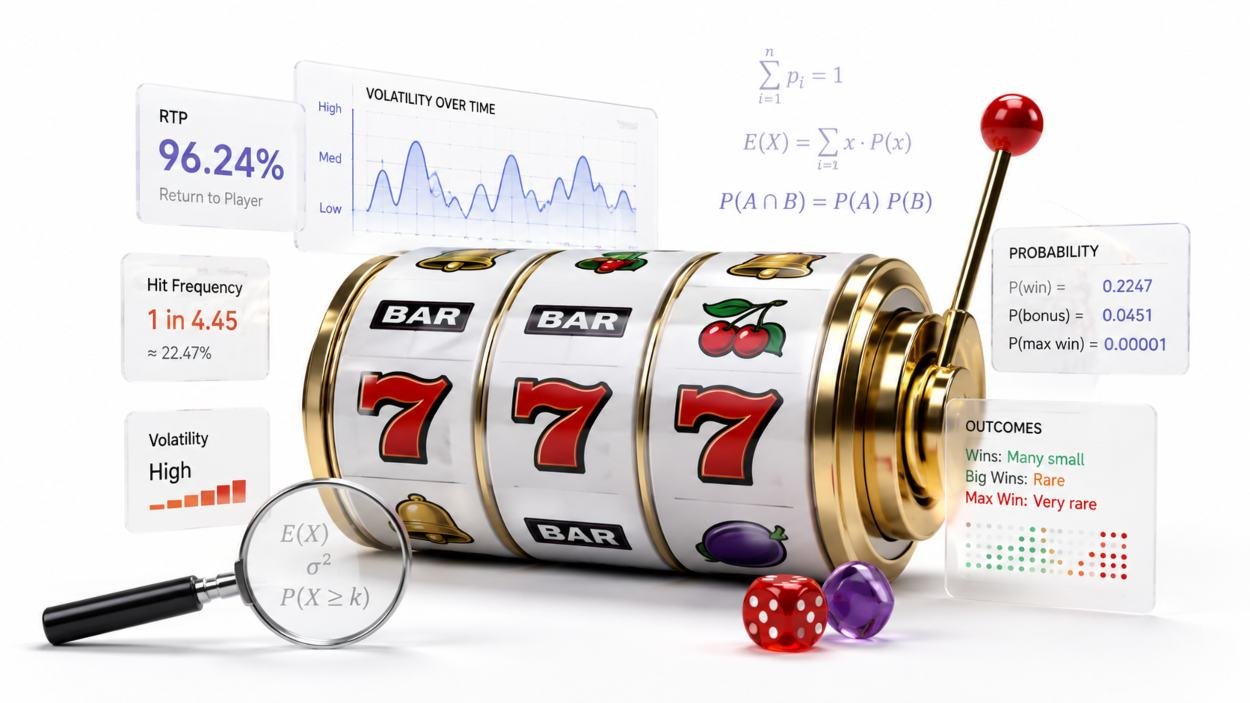
There is a version of this article on roughly four thousand websites. It explains that RTP is the long-run return percentage, that volatility describes swing size, that hit frequency counts paying spins, and it closes by telling you that understanding these three numbers turns gambling into an informed decision.
That closing claim is false, and it is the most commonly repeated falsehood in the category.
Understanding slot maths perfectly does not change your expected loss by a single unit. The house edge is a property of the game’s math model. It does not shrink because you read the info panel. What these numbers genuinely do is let you predict how a session will feel and how quickly your money will move, which is worth knowing. They do not give you an edge, and any article implying otherwise is selling you a sense of control as a substitute for information.
Here is the version that respects your intelligence.
RTP Is A Property Of The Game, Not Of Your Session
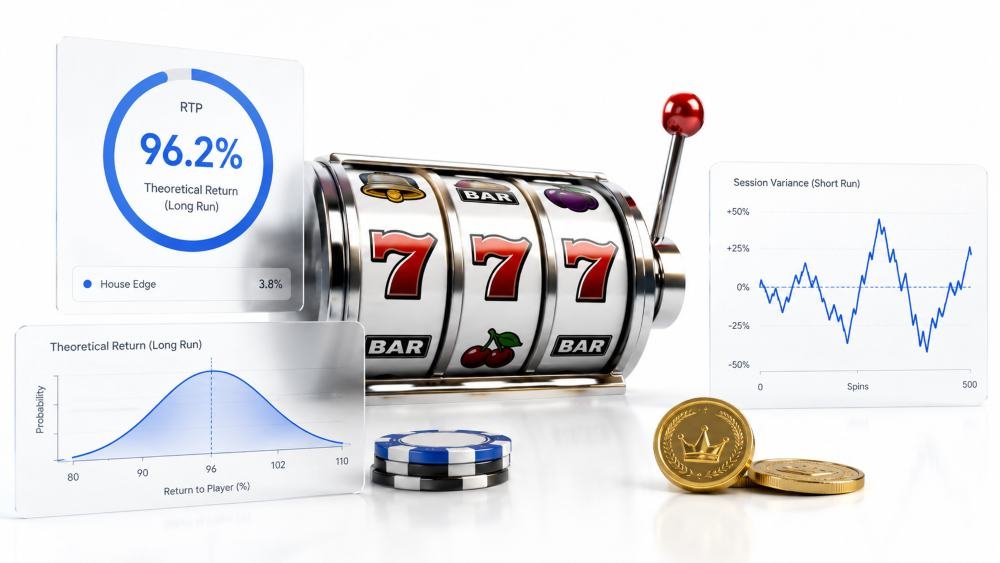
Return to player is the theoretical percentage of total stakes a game returns across its full mathematical cycle. It is calculated from the game’s paytable and reel weightings, then verified by independent test houses before certification.
In regulated markets this is not optional. Britain’s regime is the most thoroughly documented in the world, which makes it a useful reference point even for players outside it. Under the Gambling Commission’s technical standard on rules, game descriptions and the likelihood of winning, operators must make information about prizes, payouts and the way outcomes are determined available before a customer commits to gamble, including house edge or RTP.
The Commission has also confirmed, in response to a freedom of information request about slot testing, how and when games are independently checked against their stated figures. This matters more than the number itself: an RTP figure with no certification behind it is marketing copy.
The critical word in the definition is theoretical. Ninety-six per cent RTP does not mean you will get ninety-six back from a hundred. It means the game, run to completion across its entire probability space, returns ninety-six per cent. You will never run a game to completion.
Sample Size Almost No One Mentions
This is where the commodity explainers stop, and it is the part that actually matters.
How many spins does it take for your observed return to land near the theoretical RTP? Far more than anyone plays.
The arithmetic is unforgiving. On a high volatility slot, the standard deviation of a single spin’s return can run ten to twenty times the stake, because rare large outcomes dominate the distribution. To narrow an observed return to within roughly one percentage point of the theoretical figure at conventional confidence levels, you need something on the order of four to nine million spins. At the minimum legal spin duration in Britain, that is several thousand hours of continuous play.
Ten thousand spins, which is more than most players complete in a year on a single title, leaves you with an observed return that could plausibly sit twenty or thirty percentage points either side of the published number on a volatile game.
So RTP tells you something true and something useless simultaneously. True: this game is built to a 96 per cent return. Useless: nothing about what your next thousand spins will do.
Number That Actually Describes Your Exposure
Here is the figure no operator publishes, and no explainer computes, and it is trivially derivable.
The house edge is one hundred minus the RTP. At 96 per cent, the edge is 4 per cent, applied to every unit staked, every spin. Expected loss is therefore stake multiplied by spins per hour multiplied by edge.
Spin rate is the variable people ignore. Britain’s responsible product design standard requires a minimum of 2.5 seconds between the start of one slot game cycle and the point at which the next can begin. That ceiling exists precisely because cycle speed drives loss rate. In markets without such a rule, spins can run considerably faster.
Work the numbers at £1 per spin and 96 per cent RTP:
- 600 spins per hour, a realistic pace with natural pauses: £24 expected loss per hour
- 1,440 spins per hour, the theoretical maximum at 2.5 seconds: roughly £58 per hour
Now change the stake to £2 and the hourly figure doubles. Change the RTP to 94 per cent, and it rises by half again. That single calculation tells you more about a session than the entire volatility taxonomy.
How seriously regulators treat cycle speed is visible in enforcement. A supplier was recently required to pay £122,835 after a slot ran at 1.97 seconds per cycle rather than the mandated 2.5, with a portfolio audit turning up fifteen further titles that had drifted below the threshold. A shortfall of half a second was worth a six-figure penalty, because across millions of spins half a second is money.
Why Two Games With Identical RTP Feel Nothing Alike
Volatility describes the shape of the return distribution, not its mean. Two slots can both return 96 per cent while delivering it in completely different packages: one in frequent small amounts, the other concentrated in rare large hits.
The structural detail that gets omitted: in modern feature-driven slots, a substantial portion of total RTP is held inside the bonus round. The headline figure is a weighted average across every outcome, including trigger events that occur once in several hundred spins.
The consequence is arithmetically necessary. If the feature contributes positive return, then base game play alone must return less than the headline figure. A player who spins three hundred times without triggering the bonus has not been unlucky relative to the advertised RTP. They have been experiencing the base game’s own, lower return, exactly as designed. The published number is only honest across a sample that includes the features.
Some studios publish base game and feature RTP separately. Most do not. When they do, it is worth reading.
Hit Frequency Counts Events, Not Profit
Hit frequency is the proportion of spins returning any payout at all. It is routinely misread as a proxy for how well a game treats you. It is not.
A “hit” includes outcomes that return less than the stake. On multiline games, this is not an edge case; it is the dominant category. Researchers at the Gambling Research Lab at the University of Waterloo named these losses disguised as wins and have documented their effects for over a decade: players categorise them as wins, respond to them physiologically as wins, and systematically overestimate how often they actually won.
Work published in the Journal of Gambling Studies isolated the mechanism. When celebratory audio on these outcomes was replaced with negative feedback, participants correctly identified them as losses and produced accurate win estimates. The sound was carrying the misclassification.
So a 45 per cent hit frequency does not mean a generous game. It means the game pays something on forty-five spins in a hundred, and says nothing whatsoever about whether those payments exceed what you put in. Hit frequency and profitability are close to unrelated.
What These Numbers Cannot Do
- They cannot tell you what happens next. Outcomes are independent. A certified random number generator has no memory of prior spins. A game that has paid nothing for two hundred spins is not “due”, and one that just paid is not “cold”. This is the gambler’s fallacy, and it survives because sequences of random outcomes look patterned to human perception.
- They cannot be sampled meaningfully in a short session. The demo-mode routine that circulates widely, spin fifty times and count your hits, does not work. On a game with true 25 per cent hit frequency, fifty spins produces a 95 per cent range of roughly seven to eighteen hits, an observed rate anywhere from 13 to 37 per cent. That range comfortably contains a 15 per cent game and a 35 per cent game. The test cannot distinguish them. It produces a number that feels like evidence and is not.
- They cannot offset design features aimed at persistence. The Centre for Gambling Research at UBC has documented how near-miss outcomes, configurations that stop just short of a win, increase motivation to continue despite conferring no value. Knowing the RTP does not immunise you against a structural feature operating below deliberation.
Regulators have accepted this. Britain’s October 2021 revision of the technical standards prohibited turbo and slam stop features on the explicit grounds that they speed up results or give the illusion of control, alongside restrictions on autoplay and on celebratory presentation of losses disguised as wins. The phrase “illusion of control” appears in the regulator’s own reasoning. Content that promises maths literacy will hand you control is selling the exact thing the standard was written to remove.
Where The Published Figures Actually Live

Given all of the above, the figures are still worth checking, for the narrow and real purpose of knowing what you are buying.
Look in the game’s information or paytable screen first, which is where certified operators are obliged to surface it. Comparing across a catalogue is easier when the operator exposes specifications alongside each title rather than burying them, which is the practical reason to browse a structured library such as the FS.casino slots collection rather than assembling figures from third-party lists that are frequently outdated or simply wrong.
One caution that applies everywhere: the same game title can ship at different RTP settings to different operators. Studios often supply multiple configurations of one title. Always read the figure in the game you are about to open, not the figure in a review of a game with the same name.
Three Metrics, Honestly Stated
| Metric | What It Genuinely Tells You | What It Cannot Tell You |
|---|---|---|
| RTP | The game’s built-in long-run return, and by subtraction the house edge per unit staked | Anything about your session, or when a return arrives |
| Volatility | The shape of the distribution, so how large and how rare outcomes are | Whether returns are better or worse in total |
| Hit Frequency | How often any payout occurs, so the tempo of feedback | Whether those payouts exceed the stake |
| Spin Rate | Combined with stake and edge, your actual expected loss per hour | Nothing, and it is the one figure worth calculating |
Closing Note
The three published figures are real, verifiable, and worth two minutes of your attention before opening a game. Read them for what they are: a specification sheet describing how a product behaves, in the way a fuel consumption figure describes a car.
What they will not do is convert a negative expectation game into a positive one, reveal when a payout is coming, or make a session predictable. The single most useful thing you can derive from them is not the RTP itself but the hourly expected loss that falls out of it once you factor in your stake and your spin rate. That number is honest, easy to calculate, and almost never printed anywhere.
Anyone telling you that understanding slot maths puts you in control has the relationship backwards. Understanding slot maths tells you precisely how much control you do not have, which is a genuinely useful thing to know and a much harder thing to sell.
Disclaimer
This article is provided for informational purposes only. It is not gambling, financial, or legal advice, and nothing in it should be read as encouragement to gamble or as a claim that any strategy improves outcomes. No method of analysing slot machine statistics alters the mathematical expectation of any game.
Gambling carries a risk of financial loss. Certified random number generators determine slot outcomes, individual spins are statistically independent, and no published metric predicts future results. Participants must meet the minimum legal age in their jurisdiction.
Online casino availability, licensing, and legality vary substantially by country and region, and operators restrict access in numerous territories. Readers are responsible for confirming that participation is lawful where they are located and for reading operator terms directly before registering. Bonus offers carry wagering conditions that materially affect their value.
If gambling has stopped being entertainment for you or for someone close to you, free and confidential help is available. GamCare provides support, information and treatment referral, and Gambling Therapy offers free multilingual support to people worldwide. Most jurisdictions also operate their own national helpline, and licensed operators are required to provide deposit limits, reality checks, and self-exclusion tools within your account settings.
References
- Gambling Commission (Great Britain). “RTS 3: Rules, Game Descriptions and the Likelihood of Winning.” Remote Gambling and Software Technical Standards, issued under sections 89 and 97 of the Gambling Act 2005. Published 2 February 2021, last updated 31 October 2025. https://www.gamblingcommission.gov.uk/manual/remote-gambling-and-software-technical-standards/rts-3-rules-game-descriptions-and-the-likelihood-of-winning
- Gambling Commission (Great Britain). “RTS 14: Responsible Product Design.” Remote Gambling and Software Technical Standards. Requirement 14D, minimum 2.5 second game cycle for slots, in force from 31 October 2021. https://www.gamblingcommission.gov.uk/manual/remote-gambling-and-software-technical-standards/rts-14-responsible-product-design
- Gambling Commission (Great Britain). “Updates to RTS Effective 31 October 2021.” Guidance note covering requirements 14E, 8A and related provisions on turbo, slam stop, autoplay and celebratory presentation of losses disguised as wins. https://www.gamblingcommission.gov.uk/licensees-and-businesses/guide/page/updates-to-rts-effective-31-october-2021
- Gambling Commission (Great Britain). “Testing of Online Slots.” Freedom of Information Act 2000 response concerning independent testing frequency for stated RTP on games available to British consumers. https://www.gamblingcommission.gov.uk/about-us/freedomofinformation/testing-of-online-slots
- Dixon, Mike J. Faculty profile and Gambling Research Lab overview, Department of Psychology, University of Waterloo, Waterloo, Ontario, Canada. https://uwaterloo.ca/psychology/profiles/mike-j-dixon
- Dixon, Mike J., Karen Collins, Kevin A. Harrigan, Candice Graydon, and Jonathan A. Fugelsang. “Using Sound to Unmask Losses Disguised as Wins in Multiline Slot Machines.” Journal of Gambling Studies, vol. 30, no. 1 (2014), pp. 183–196. First published online November 2013. DOI: 10.1007/s10899-013-9411-8. https://link.springer.com/article/10.1007/s10899-013-9411-8
- Centre for Gambling Research at UBC. Research programme overview, Department of Psychology, University of British Columbia, Vancouver, Canada. Directed by Prof. Luke Clark. https://cgr.psych.ubc.ca/research/
- Yogonet International. “Stakelogic to Pay £122,835 After Slots Games Breach Minimum Spin-Speed Rules.” 30 June 2026. https://www.yogonet.com/international/news/2026/06/30/125135-stakelogic-to-pay-122-835-after-slots-games-breach-minimum-spinspeed-rules
- GamCare. Support, information and treatment services for people affected by gambling harm. United Kingdom. https://www.gamcare.org.uk/
- Gambling Therapy. Free multilingual online support service for people affected by gambling worldwide, operated by Gordon Moody. https://www.gamblingtherapy.org/